
Supporting Your Child's Communication Journey
You know your child better than anyone. If something feels off — if they seem frustrated when they can't express themselves, if other kids are hard to understand where your child isn't, if they've stopped making progress or seem to be falling behind — trust that instinct. That's what brought you here, and it's exactly the right first step.
Signs your child may benefit - by age
12–24 Months
Not babbling or making sounds by 12 months
Not pointing or waving by 12 months
Not saying any single words by 16 months
Not combining two words ("more milk," "bye dada") by 24 months
Loss of previously learned words or sounds at any point
Ages 3–4
Difficult for people outside the family to understand their speech
Limited vocabulary compared to other children the same age
Frequently leaving out sounds at the beginning or end of words
Frustration, meltdowns, or withdrawal when communication breaks down
Trouble following two-step directions ("Get your shoes and put them by the door")
Ages 5 and Up
Stuttering or struggling with the flow of speech
Difficulty telling stories, explaining events, or staying on topic
Challenges making friends, joining conversations, or understanding social cues
Reading or writing difficulties that may be tied to underlying language challenges
A teacher has expressed concerns about communication or language
And at any age — if your gut is telling you something isn't quite right, that's worth a conversation. An evaluation will either give you peace of mind or a clear path forward.
What To Expect
〰️
What To Expect 〰️
Step 1:
Free Consultation
(30 minutes)
We start with a no-pressure conversation — by phone or video — where you tell me about your child and I answer your questions. This is where we decide together whether an evaluation makes sense.
Step 2: Comprehensive Evaluation
A thorough assessment of your child's speech and language skills using standardized tools and clinical observation. I'll look at how your child understands language, expresses themselves, produces sounds, and interacts with others. You'll receive a written report with my findings and recommendations.
Step 3: Personalized Treatment Plan
We build a plan together — one that reflects your child's specific goals, your family's schedule, and the environments where they spend their time. I'll explain exactly what we're targeting and why.
Step 4:
Ongoing Therapy & Parent Partnership
Sessions happen in your home, via telehealth, or a combination of both. After every session you'll receive a brief update and home practice activities — because what happens between sessions matters just as much as what happens during them. We'll check in regularly on progress and adjust goals as your child grows.
Pricing
For services offered in home and online.
Initial consultation - 30 minutes
FREE
Speech-Language Therapy - 30 minutes
$65
Speech-Language Therapy - 60 minutes
$110
Evaluation of Speech Skills Only
$200
Evaluation of Speech and Language Skills
$350
Frequently Asked Questions
-
No referral needed. Families can reach out directly to schedule a free consultation. If a referral from your pediatrician is useful for your own records, we're happy to coordinate with your child's provider.
-
Breaking Barriers LLC is a private-pay practice, which means we do not bill insurance directly. This allows us to keep sessions focused entirely on your child — without restrictions on session length, frequency, or treatment approach that insurance companies often impose.
Many families use their HSA (Health Savings Account) or FSA (Flexible Spending Account) debit card to pay for services directly, as speech therapy is an IRS-qualified medical expense. We also provide detailed superbills upon request, which you can submit to your insurance company for potential out-of-network reimbursement. We recommend calling your insurance company ahead of time to ask about your out-of-network speech therapy benefits.
-
Most children benefit from one to two sessions per week, depending on their goals and the nature of their communication challenges. We'll discuss the recommended frequency during the consultation and adjust as your child progresses.
-
School-based SLPs focus on how communication affects a student's ability to access their education — and eligibility is based on that educational impact. Some children with real communication needs don't qualify for school services, or receive limited minutes that aren't enough to make meaningful progress.
Private therapy has no eligibility restrictions. We work with any child who would benefit, set goals based on the whole child (not just classroom function), and have the flexibility to provide more intensive support. Private and school services can also work together — we're happy to collaborate with your child's school team.
-
We work with children from approximately age 2 through high school. Early intervention is a particular priority — the research is clear that earlier support leads to faster and more lasting progress.
-
Every child's timeline is different. Some children reach their goals in just a few months; others benefit from longer-term support. We'll talk about realistic expectations during the evaluation and revisit goals regularly to make sure therapy is working and progressing.
-
Yes — and it works beautifully for most children. Telehealth sessions are conducted via a secure, HIPAA-compliant video platform. Research consistently shows that telehealth speech therapy is as effective as in-person services for most communication goals. It's also a great option for families farther from Salida or with busy schedules. We can also do a combination of in-home and telehealth sessions.
-
Cancellation made 24+ hours in advance, no charge.
Late cancellation (less than 24 hours) 50% of session fee
No-shows without notice, full session fee
We understand that emergencies happen. Please contact us as soon as possible if you need to cancel.
-
Breaking Barriers LLC is an out-of-network provider and does not bill insurance directly. We are happy to provide a superbill — a detailed receipt with the diagnostic and procedure codes your insurance plan requires — that you can submit for potential out-of-network reimbursement.
To check your out-of-network benefits, call the member services number on your insurance card and ask:
• "Do I have out-of-network speech therapy benefits?"
• "What is my out-of-network deductible and has it been met?"
• "What percentage do you reimburse for CPT codes 92507 and 92521?"
HSA/FSA cards are accepted. Speech therapy is a qualified medical expense.
Parent Resources
Speech & Language Milestones
Not sure what's typical for your child's age? ASHA (the American Speech-Language-Hearing Association) offers a free, easy-to-read milestones guide at asha.org — search "speech and language milestones."
Helpful Books for Parents
"It Takes Two to Talk" by Jan Hanen — for parents of toddlers with language delays. Practical, warm, and widely recommended.
"The Late Talker" by Marilyn Agin — a compassionate guide for families concerned about early speech and language development.
Simple Things You Can Do at Home
Read together every day — even just 10 minutes. Narrate the pictures. Ask "what's that?" and wait.
Expand what your child says by adding one or two words. If they say "ball," you say "yes, big red ball!"
Replace questions with comments. Instead of "What's that?", try "Oh, I see a dog!" — it reduces pressure and models language at the same time.
Give your child time to respond. Count to 10 silently before jumping in. That pause is where language happens.
Get on their level — sit face-to-face and follow their lead during play. Communication is a two-way street.
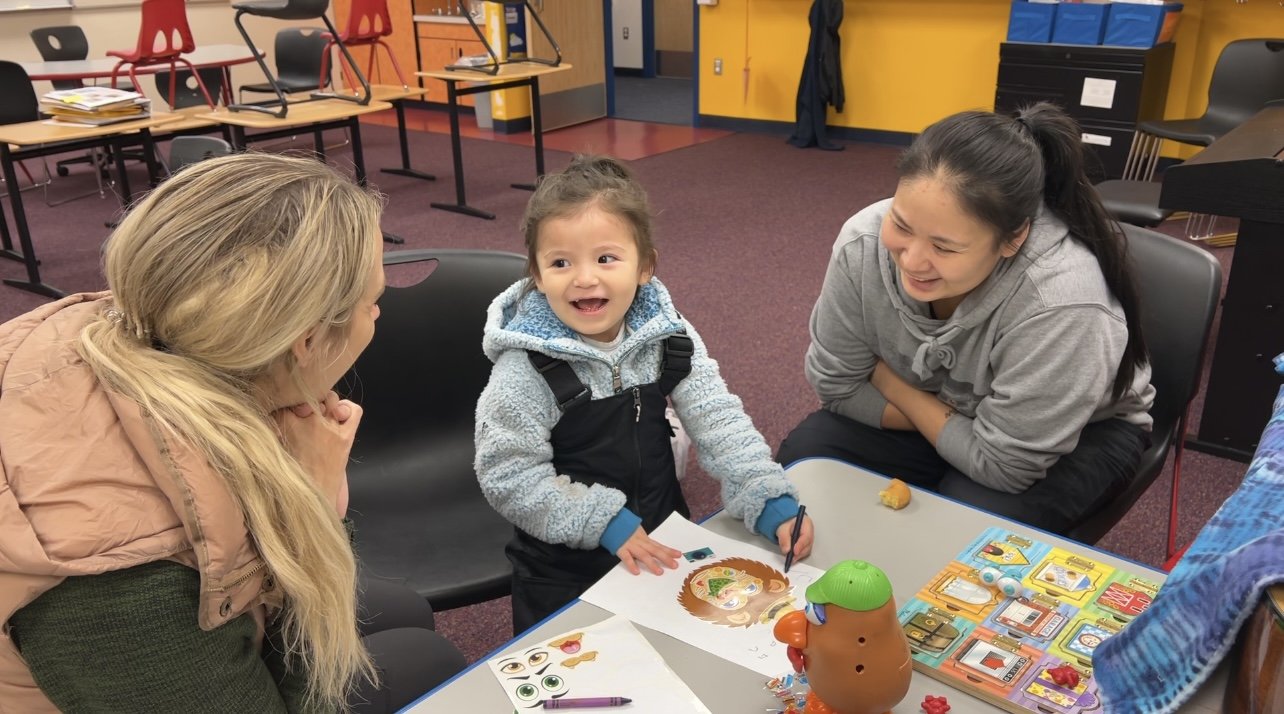
Ready to Take the First Step?
Schedule a free 30-minute consultation to talk about your child's communication goals. No referral needed. No pressure. Just a real conversation about how we can help.